Skip over navigation
Cambridge University Faculty of Mathematics NRich logo
menu search
  • Teachers expand_more
    • Early years
    • Primary
    • Secondary
    • Post-16
    • Events
    • Professional development
  • Students expand_more
    • Primary
    • Secondary
    • Post-16
  • Parents expand_more
    • Early Years
    • Primary
    • Secondary
    • Post-16
  • Problem-Solving Schools
  • About NRICH expand_more
    • About us
    • Impact stories
    • Support us
    • Our funders
    • Contact us
  • search

Or search by topic

Number and algebra

  • The Number System and Place Value
  • Calculations and Numerical Methods
  • Fractions, Decimals, Percentages, Ratio and Proportion
  • Properties of Numbers
  • Patterns, Sequences and Structure
  • Algebraic expressions, equations and formulae
  • Coordinates, Functions and Graphs

Geometry and measure

  • Angles, Polygons, and Geometrical Proof
  • 3D Geometry, Shape and Space
  • Measuring and calculating with units
  • Transformations and constructions
  • Pythagoras and Trigonometry
  • Vectors and Matrices

Probability and statistics

  • Handling, Processing and Representing Data
  • Probability

Working mathematically

  • Thinking mathematically
  • Developing positive attitudes
  • Cross-curricular contexts

Advanced mathematics

  • Decision Mathematics and Combinatorics
  • Advanced Probability and Statistics
  • Mechanics
  • Calculus

For younger learners

  • Early Years Foundation Stage
NRICH topics: Properties of numbers Powers and roots

Resources tagged with: Powers and roots

Content type:
Age range:
Challenge level:

There are 54 NRICH Mathematical resources connected to Powers and roots, you may find related items under Properties of numbers.

Broad Topics > Properties of numbers > Powers and roots


Problem Primary curriculum Secondary curriculum

Pocket Money

Which of these pocket money systems would you rather have?

Age 11 to 14
Challenge Level Yellow star
Problem Primary curriculum Secondary curriculum

Double Trouble

Simple additions can lead to intriguing results...

Age 14 to 16
Challenge Level Yellow star
Problem Primary curriculum Secondary curriculum

Fit for Photocopying

Explore the relationships between different paper sizes.

Age 14 to 16
Challenge Level Yellow starYellow starYellow star
Problem Primary curriculum Secondary curriculum

Power Countdown

In this twist on the well-known Countdown numbers game, use your knowledge of Powers and Roots to make a target.


Age 14 to 16
Challenge Level Yellow star
Problem Primary curriculum Secondary curriculum

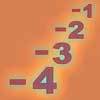
Power Mad!

Powers of numbers behave in surprising ways. Take a look at some of these and try to explain why they are true.
Age 11 to 14
Challenge Level Yellow starYellow star
Problem Primary curriculum Secondary curriculum

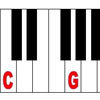
Negative Power

What does this number mean ? Which order of 1, 2, 3 and 4 makes the highest value ? Which makes the lowest ?
Age 14 to 16
Challenge Level Yellow starYellow starYellow star
Problem Primary curriculum Secondary curriculum

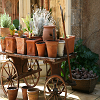
Equal Temperament

The scale on a piano does something clever : the ratio (interval) between any adjacent points on the scale is equal. If you play any note, twelve points higher will be exactly an octave on.
Age 14 to 16
Challenge Level Yellow starYellow starYellow star
Problem Primary curriculum Secondary curriculum

More Magic Potting Sheds

The number of plants in Mr McGregor's magic potting shed increases overnight. He'd like to put the same number of plants in each of his gardens, planting one garden each day. How can he do it?
Age 11 to 16
Challenge Level Yellow starYellow starYellow star
Problem Primary curriculum Secondary curriculum

Magic Potting Sheds

Mr McGregor has a magic potting shed. Overnight, the number of plants in it doubles. He'd like to put the same number of plants in each of three gardens, planting one garden each day. Can he do it?
Age 11 to 16
Challenge Level Yellow starYellow star
Problem Primary curriculum Secondary curriculum

Perfectly Square

The sums of the squares of three related numbers is also a perfect square - can you explain why?

Age 14 to 16
Challenge Level Yellow starYellow star
Problem Primary curriculum Secondary curriculum

Guesswork

Ask a friend to choose a number between 1 and 63. By identifying which of the six cards contains the number they are thinking of it is easy to tell them what the number is.

Age 14 to 16
Challenge Level Yellow starYellow starYellow star
Problem Primary curriculum Secondary curriculum

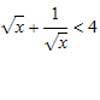
In Between

Can you find the solution to this algebraic inequality?

Age 16 to 18
Challenge Level Yellow starYellow star
Problem Primary curriculum Secondary curriculum

What an Odd Fact(or)

Can you show that 1^99 + 2^99 + 3^99 + 4^99 + 5^99 is divisible by 5?
Age 11 to 14
Challenge Level Yellow starYellow starYellow star
Problem Primary curriculum Secondary curriculum

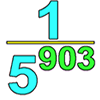
Sept 03

What is the last digit of the number 1 / 5^903 ?

Age 11 to 14
Challenge Level Yellow starYellow star
Problem Primary curriculum Secondary curriculum

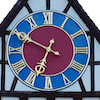
Cubes Within Cubes

We start with one yellow cube and build around it to make a 3x3x3 cube with red cubes. Then we build around that red cube with blue cubes and so on. How many cubes of each colour have we used?
Age 7 to 14
Challenge Level Yellow starYellow starYellow star
Problem Primary curriculum Secondary curriculum

The Root of the Problem

Find the sum of this series of surds.

Age 14 to 18
Challenge Level Yellow starYellow star
Problem Primary curriculum Secondary curriculum

Number Rules - OK

Can you produce convincing arguments that a selection of statements about numbers are true?

Age 14 to 16
Challenge Level Yellow starYellow star
Problem Primary curriculum Secondary curriculum

Giants

Which is the bigger, 9^10 or 10^9 ? Which is the bigger, 99^100 or 100^99 ?
Age 16 to 18
Challenge Level Yellow starYellow star
Problem Primary curriculum Secondary curriculum

Surds

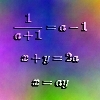
Find the exact values of x, y and a satisfying the following system of equations: 1/(a+1) = a - 1 x + y = 2a x = ay
Age 14 to 16
Challenge Level Yellow starYellow star
Problem Primary curriculum Secondary curriculum

Root to Poly

Find the polynomial p(x) with integer coefficients such that one solution of the equation p(x)=0 is $1+\sqrt 2+\sqrt 3$.

Age 14 to 16
Challenge Level Yellow starYellow starYellow star
Problem Primary curriculum Secondary curriculum

How Many Solutions?

Find all the solutions to the this equation.

Age 16 to 18
Challenge Level Yellow star
Problem Primary curriculum Secondary curriculum

Em'power'ed

Find the smallest numbers a, b, and c such that: a^2 = 2b^3 = 3c^5 What can you say about other solutions to this problem?

Age 16 to 18
Challenge Level Yellow starYellow star
Problem Primary curriculum Secondary curriculum

Ab Surd Ity

Find the value of sqrt(2+sqrt3)-sqrt(2-sqrt3)and then of cuberoot(2+sqrt5)+cuberoot(2-sqrt5).
Age 16 to 18
Challenge Level Yellow star
Problem Primary curriculum Secondary curriculum

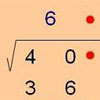
Archimedes Numerical Roots

How did Archimedes calculate the lengths of the sides of the polygons which needed him to be able to calculate square roots?
Age 16 to 18
Challenge Level Yellow star
Problem Primary curriculum Secondary curriculum

Unusual Long Division - Square Roots Before Calculators

However did we manage before calculators? Is there an efficient way to do a square root if you have to do the work yourself?
Age 14 to 16
Challenge Level Yellow starYellow starYellow star
Problem Primary curriculum Secondary curriculum

Bina-ring

Investigate powers of numbers of the form (1 + sqrt 2).

Age 16 to 18
Challenge Level Yellow starYellow starYellow star
Problem Primary curriculum Secondary curriculum

Plus or Minus

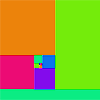
Make and prove a conjecture about the value of the product of the Fibonacci numbers $F_{n+1}F_{n-1}$.
Age 16 to 18
Challenge Level Yellow starYellow starYellow star
Problem Primary curriculum Secondary curriculum

Pythagorean Fibs

What have Fibonacci numbers got to do with Pythagorean triples?

Age 16 to 18
Challenge Level Yellow starYellow star
Problem Primary curriculum Secondary curriculum

Fibonacci Fashion

What have Fibonacci numbers to do with solutions of the quadratic equation x^2 - x - 1 = 0 ?

Age 16 to 18
Challenge Level Yellow starYellow star
Problem Primary curriculum Secondary curriculum

Golden Eggs

Find a connection between the shape of a special ellipse and an infinite string of nested square roots.

Age 16 to 18
Challenge Level Yellow starYellow star
Article Primary curriculum Secondary curriculum

St Ives

As I was going to St Ives, I met a man with seven wives. Every wife had seven sacks, every sack had seven cats, every cat had seven kittens. Kittens, cats, sacks and wives, how many were going to St Ives?

Age 7 to 11
Problem Primary curriculum Secondary curriculum

Lost in Space

How many ways are there to count 1 - 2 - 3 in the array of triangular numbers? What happens with larger arrays? Can you predict for any size array?
Age 14 to 16
Challenge Level Yellow star
Problem Primary curriculum Secondary curriculum

Lastly - Well

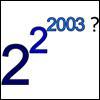
What are the last two digits of 2^(2^2003)?

Age 11 to 14
Challenge Level Yellow starYellow starYellow star
Problem Primary curriculum Secondary curriculum

Cube Roots

Evaluate without a calculator: (5 sqrt2 + 7)^{1/3} - (5 sqrt2 - 7)^1/3}.
Age 16 to 18
Challenge Level Yellow starYellow starYellow star
Problem Primary curriculum Secondary curriculum

Largest Number

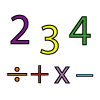
What is the largest number you can make using the three digits 2, 3 and 4 in any way you like, using any operations you like? You can only use each digit once.

Age 11 to 14
Challenge Level Yellow star
Problem Primary curriculum Secondary curriculum

Enriching Experience

Find the five distinct digits N, R, I, C and H in the following nomogram
Age 14 to 16
Challenge Level Yellow star
Problem Primary curriculum Secondary curriculum

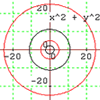
Square Pair Circles

Investigate the number of points with integer coordinates on circles with centres at the origin for which the square of the radius is a power of 5.

Age 16 to 18
Challenge Level Yellow starYellow star
Problem Primary curriculum Secondary curriculum

Archimedes and Numerical Roots

The problem is how did Archimedes calculate the lengths of the sides of the polygons which needed him to be able to calculate square roots?
Age 14 to 16
Challenge Level Yellow starYellow star
Problem Primary curriculum Secondary curriculum

Power Crazy

What can you say about the values of n that make $7^n + 3^n$ a multiple of 10? Are there other pairs of integers between 1 and 10 which have similar properties?
Age 11 to 14
Challenge Level Yellow starYellow star
Problem Primary curriculum Secondary curriculum

Deep Roots

Find integer solutions to: $\sqrt{a+b\sqrt{x}} + \sqrt{c+d.\sqrt{x}}=1$
Age 14 to 16
Challenge Level Yellow starYellow starYellow star
Problem Primary curriculum Secondary curriculum

Two Many

What is the least square number which commences with six two's?
Age 11 to 14
Challenge Level Yellow star
Problem Primary curriculum Secondary curriculum

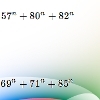
Like Powers

Investigate $1^n + 19^n + 20^n + 51^n + 57^n + 80^n + 82^n $ and $2^n + 12^n + 31^n + 40^n + 69^n + 71^n + 85^n$ for different values of n.

Age 11 to 14
Challenge Level Yellow star
Problem Primary curriculum Secondary curriculum

Rachel's Problem

Is it true that $99^n$ has 2n digits and $999^n$ has 3n digits? Investigate!

Age 14 to 16
Challenge Level Yellow starYellow starYellow star
Problem Primary curriculum Secondary curriculum

Consecutive Squares

The squares of any 8 consecutive numbers can be arranged into two sets of four numbers with the same sum. True of false?
Age 14 to 16
Challenge Level Yellow starYellow star
Problem Primary curriculum Secondary curriculum

Staircase

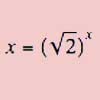
Solving the equation x^3 = 3 is easy but what about solving equations with a 'staircase' of powers?

Age 16 to 18
Challenge Level Yellow star
Problem Primary curriculum Secondary curriculum

Mod 7

Find the remainder when 3^{2001} is divided by 7.

Age 16 to 18
Challenge Level Yellow star
Problem Primary curriculum Secondary curriculum

Rationals Between...

What fractions can you find between the square roots of 65 and 67?
Age 14 to 16
Challenge Level Yellow starYellow star
Problem Primary curriculum Secondary curriculum

Rational Roots

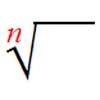
Given that a, b and c are natural numbers show that if sqrt a+sqrt b is rational then it is a natural number. Extend this to 3 variables.
Age 16 to 18
Challenge Level Yellow starYellow starYellow star
Problem Primary curriculum Secondary curriculum

Route to Root

A sequence of numbers x1, x2, x3, ... starts with x1 = 2, and, if you know any term xn, you can find the next term xn+1 using the formula: xn+1 = (xn + 3/xn)/2 . Calculate the first six terms of this sequence. What do you notice? Calculate a few more terms and find the squares of the terms. Can you prove that the special property you notice about this sequence will apply to all the later terms of the sequence? Write down a formula to give an approximation to the cube root of a number and test it for the cube root of 3 and the cube root of 8. How many terms of the sequence do you have to take before you get the cube root of 8 correct to as many decimal places as your calculator will give? What happens when you try this method for fourth roots or fifth roots etc.?

Age 16 to 18
Challenge Level Yellow star
Problem Primary curriculum Secondary curriculum

Absurdity Again

What is the value of the integers a and b where sqrt(8-4sqrt3) = sqrt a - sqrt b?

Age 16 to 18
Challenge Level Yellow star

  • Tech help
  • Accessibility Statement
  • Sign up to our newsletter
  • Twitter X logo

The NRICH Project aims to enrich the mathematical experiences of all learners. To support this aim, members of the NRICH team work in a wide range of capacities, including providing professional development for teachers wishing to embed rich mathematical tasks into everyday classroom practice.

NRICH is part of the family of activities in the Millennium Mathematics Project.

University of Cambridge logo NRICH logo