Skip over navigation


Before reading this article, you may like to read Manipulatives in the Primary Classroom which offers research-based guidance about using hands-on equipment in the teaching and learning of mathematics.
Interlocking cubes are a versatile resource which are powerful for modelling the mathematics of problems and are therefore a must-have for all primary classrooms. Unlike, for example, Dienes apparatus or Cuisenaire rods, interlocking cubes have no underlying mathematical structure, so offer us a great deal of flexibility, meaning they can often be used to suit the particular problem in hand. In this article, I will outline four different ways in which cubes can support children in their ability to work mathematically and I will suggest tasks that exemplify each, all of which can be found in our Cubes Feature.
1. Developing conceptual understanding
Cubes have the potential to support understanding of conceptual understanding through helping us model and visualise mathematics.
Creating physical models out of cubes, which almost all our chosen tasks involve, will help learners develop their spatial awareness in a very general sense and, if given opportunities to talk about what they are doing, children will become more fluent in their use of positional and spatial language. In addition, the process of building and pulling apart can support understanding of specific concepts such as surface area and scaling.
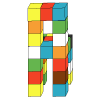 The lower primary task, Building with Cubes, will help familiarise learners with positional language as they are challenged to make a 'building', which is described to them orally. Chairs and Tables offers the story of 'Goldilocks and the Three Bears' as a context in which to
focus on the idea of relative size. The challenge is to create a chair for each of the three bears and then a table for each chair. Brush Loads is a higher-level task, but still very accessible, which invites pupils to create different arrangements of five cubes and to investigate the number of 'brush loads' of paint needed to cover each. It could be used to
introduce learners to the concept of surface area.
The lower primary task, Building with Cubes, will help familiarise learners with positional language as they are challenged to make a 'building', which is described to them orally. Chairs and Tables offers the story of 'Goldilocks and the Three Bears' as a context in which to
focus on the idea of relative size. The challenge is to create a chair for each of the three bears and then a table for each chair. Brush Loads is a higher-level task, but still very accessible, which invites pupils to create different arrangements of five cubes and to investigate the number of 'brush loads' of paint needed to cover each. It could be used to
introduce learners to the concept of surface area.
Giving children chances to use interlocking cubes to represent numbers will deepen their understanding of number properties and equip them with a mental image to draw upon subsequently. Numbers as Shapes offers visual images for prime numbers and square numbers; the group task Even and Odd gives learners a way of 'seeing' even and odd numbers (as the name suggests!) and Making Sticks encourages children to explore the concept of multiples in a practical way.
2. Developing problem-solving skills
In her article Developing Excellence in Problem Solving with Young Learners, Jennie Pennant suggests that one way in which we can support children in becoming confident and competent problem solvers is by 'explicitly and repeatedly providing children with opportunities to develop key problem-solving skills'. In the tasks we have chosen, interlocking cubes are a useful context in which to encourage development of a number of different problem-solving skills, including working systematically, pattern spotting, generalising and visualising.
Working systematically
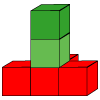 3 Blocks Towers is a 'finding all possibilities' problem which, because it can be done practically, is accessible to the majority of children. Making many different towers with the cubes allows learners to compare them by asking themselves 'what's the same?' and 'what's
different?'. The ability to distinguish similarities and differences is a vital ingredient in working systematically. By ordering according to similarities, children can impose a system on the towers they have made, which helps to reveal those that are missing. Once they have had opportunities to do this sorting and ordering in many contexts, learners will be able to create
examples in a systematic way from the start. Cubes Here and There is a more challenging task but the aim, and therefore the process, is the same - to find all solutions. Both these activities also contribute to children's developing spatial properties in a general sense, as outlined above. (See our Working Systematically Feature for more
information on ways to develop this problem-solving skill.)
3 Blocks Towers is a 'finding all possibilities' problem which, because it can be done practically, is accessible to the majority of children. Making many different towers with the cubes allows learners to compare them by asking themselves 'what's the same?' and 'what's
different?'. The ability to distinguish similarities and differences is a vital ingredient in working systematically. By ordering according to similarities, children can impose a system on the towers they have made, which helps to reveal those that are missing. Once they have had opportunities to do this sorting and ordering in many contexts, learners will be able to create
examples in a systematic way from the start. Cubes Here and There is a more challenging task but the aim, and therefore the process, is the same - to find all solutions. Both these activities also contribute to children's developing spatial properties in a general sense, as outlined above. (See our Working Systematically Feature for more
information on ways to develop this problem-solving skill.)
Pattern spotting and generalising
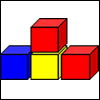 It can be tempting to ask children to look for number patterns without giving them opportunities to find out why those patterns occur. Using interlocking cubes for this purpose supports learners, partly because of the visual clues, but also due to the fact that in the process of physically creating, patterns
may become more evident. Up and Down Staircases and Picture a Pyramid ... are good examples of such tasks.
It can be tempting to ask children to look for number patterns without giving them opportunities to find out why those patterns occur. Using interlocking cubes for this purpose supports learners, partly because of the visual clues, but also due to the fact that in the process of physically creating, patterns
may become more evident. Up and Down Staircases and Picture a Pyramid ... are good examples of such tasks.
Visualising
In section 1 above, we suggested that cubes can help children to visualise mathematical concepts. Visualising is also a useful problem-solving skill but it is perhaps not so well recognised in that context. Specifically giving children opportunities to visualise, as in Building with Cubes, will give you chances to talk about what it means and how it is useful, so that learners become more accustomed to using it themselves as they tackle problems. In Up and Down Staircases, the interactive in the 'Getting started' section may encourage children to try and visualise why the total number of cubes is always a square number.
3. Fluency
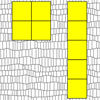 Helping children to create mental images, as described in the first section about number concept development, will aid their ability to become fluent in number. At first, learners use cubes to create physical models of numbers (as in Numbers as Shapes, Even and Odd
and Making Sticks), exploring these over a long period of time. We must then help them make the links to mental work and recording. This move from concrete to abstract is a key part of helping children to become more fluent (see our article Developing Number Fluency - What, Why and How).
Helping children to create mental images, as described in the first section about number concept development, will aid their ability to become fluent in number. At first, learners use cubes to create physical models of numbers (as in Numbers as Shapes, Even and Odd
and Making Sticks), exploring these over a long period of time. We must then help them make the links to mental work and recording. This move from concrete to abstract is a key part of helping children to become more fluent (see our article Developing Number Fluency - What, Why and How).
Offering children opportunities of consolidation in meaningful contexts is another way to improve fluency. For example, as learners tackle Brush Loads, the act of counting the number of brush loads for each arrangement of cubes means they are constantly practising how to find surface area. This is meaningful because they have the goal of maximising in mind, they are not finding each surface area simply for the sake of it.
4. Reasoning
 The activities in this Cubes Feature offer opportunities for children to reason in different ways and for different purposes.
Chairs and Tables presents a range of starting points and no one 'right' answer, meaning that learners have to reason simply to get started on the task. Even and Odd is a group task, so not only are you reasoning yourself, you are trying to understand the reasoning of other members of your group, all without being able to speak! 3 Blocks Towers and Cubes Here and There involve logical reasoning in explaining how you know that you have found all the solutions. In Building with Cubes, you have to use reasoning to make sense of the information which is given, bit by bit. Numbers as Shapes, Making Sticks, Up and Down Staircases, Brush Loads and Picture a Pyramid ... all demand generalisations, which necessarily involve reasoning.
Interlocking cubes and the new national curriculum in England
Those of us teaching in England are currently (May 2014) in the transition phase between old and new national curricular. The new mathematics national curriculum has three aims relating to problem solving, reasoning and fluency, and as discussed above, using well-chosen tasks which involve cubes can certainly help to achieve all three. It also contains more challenging content compared with the old version, so having mental images to draw upon will really help children as the complexity of challenge develops, and interlocking cubes can play an important role in this respect. (To find out more about the importance of mathematical models and mental images, see the articles From Objects and Images to Mathematical Ideas and Models in Mind.)
And finally ...
You can find many more lower primary activities which make use of interlocking cubes here and further upper primary tasks here. You may also wish to read the short article Many Ideas with a Few Cubes, which was originally written for the Mathematical Association's journal, Equals. It gives a brief overview of a few other cube activities and suggests that they could be used to focus teachers' attention on sharing ideas and precision of arguments.
Here is a PDF version of this article.
Take Some ... Cubes
Before reading this article, you may like to read Manipulatives in the Primary Classroom which offers research-based guidance about using hands-on equipment in the teaching and learning of mathematics.
Interlocking cubes are a versatile resource which are powerful for modelling the mathematics of problems and are therefore a must-have for all primary classrooms. Unlike, for example, Dienes apparatus or Cuisenaire rods, interlocking cubes have no underlying mathematical structure, so offer us a great deal of flexibility, meaning they can often be used to suit the particular problem in hand. In this article, I will outline four different ways in which cubes can support children in their ability to work mathematically and I will suggest tasks that exemplify each, all of which can be found in our Cubes Feature.
1. Developing conceptual understanding
Cubes have the potential to support understanding of conceptual understanding through helping us model and visualise mathematics.
Creating physical models out of cubes, which almost all our chosen tasks involve, will help learners develop their spatial awareness in a very general sense and, if given opportunities to talk about what they are doing, children will become more fluent in their use of positional and spatial language. In addition, the process of building and pulling apart can support understanding of specific concepts such as surface area and scaling.
The lower primary task, Building with Cubes, will help familiarise learners with positional language as they are challenged to make a 'building', which is described to them orally. Chairs and Tables offers the story of 'Goldilocks and the Three Bears' as a context in which to
focus on the idea of relative size. The challenge is to create a chair for each of the three bears and then a table for each chair. Brush Loads is a higher-level task, but still very accessible, which invites pupils to create different arrangements of five cubes and to investigate the number of 'brush loads' of paint needed to cover each. It could be used to
introduce learners to the concept of surface area.Giving children chances to use interlocking cubes to represent numbers will deepen their understanding of number properties and equip them with a mental image to draw upon subsequently. Numbers as Shapes offers visual images for prime numbers and square numbers; the group task Even and Odd gives learners a way of 'seeing' even and odd numbers (as the name suggests!) and Making Sticks encourages children to explore the concept of multiples in a practical way.
2. Developing problem-solving skills
In her article Developing Excellence in Problem Solving with Young Learners, Jennie Pennant suggests that one way in which we can support children in becoming confident and competent problem solvers is by 'explicitly and repeatedly providing children with opportunities to develop key problem-solving skills'. In the tasks we have chosen, interlocking cubes are a useful context in which to encourage development of a number of different problem-solving skills, including working systematically, pattern spotting, generalising and visualising.
Working systematically
3 Blocks Towers is a 'finding all possibilities' problem which, because it can be done practically, is accessible to the majority of children. Making many different towers with the cubes allows learners to compare them by asking themselves 'what's the same?' and 'what's
different?'. The ability to distinguish similarities and differences is a vital ingredient in working systematically. By ordering according to similarities, children can impose a system on the towers they have made, which helps to reveal those that are missing. Once they have had opportunities to do this sorting and ordering in many contexts, learners will be able to create
examples in a systematic way from the start. Cubes Here and There is a more challenging task but the aim, and therefore the process, is the same - to find all solutions. Both these activities also contribute to children's developing spatial properties in a general sense, as outlined above. (See our Working Systematically Feature for more
information on ways to develop this problem-solving skill.)Pattern spotting and generalising
It can be tempting to ask children to look for number patterns without giving them opportunities to find out why those patterns occur. Using interlocking cubes for this purpose supports learners, partly because of the visual clues, but also due to the fact that in the process of physically creating, patterns
may become more evident. Up and Down Staircases and Picture a Pyramid ... are good examples of such tasks.Visualising
In section 1 above, we suggested that cubes can help children to visualise mathematical concepts. Visualising is also a useful problem-solving skill but it is perhaps not so well recognised in that context. Specifically giving children opportunities to visualise, as in Building with Cubes, will give you chances to talk about what it means and how it is useful, so that learners become more accustomed to using it themselves as they tackle problems. In Up and Down Staircases, the interactive in the 'Getting started' section may encourage children to try and visualise why the total number of cubes is always a square number.
3. Fluency
Helping children to create mental images, as described in the first section about number concept development, will aid their ability to become fluent in number. At first, learners use cubes to create physical models of numbers (as in Numbers as Shapes, Even and Odd
and Making Sticks), exploring these over a long period of time. We must then help them make the links to mental work and recording. This move from concrete to abstract is a key part of helping children to become more fluent (see our article Developing Number Fluency - What, Why and How).Offering children opportunities of consolidation in meaningful contexts is another way to improve fluency. For example, as learners tackle Brush Loads, the act of counting the number of brush loads for each arrangement of cubes means they are constantly practising how to find surface area. This is meaningful because they have the goal of maximising in mind, they are not finding each surface area simply for the sake of it.
4. Reasoning
The activities in this Cubes Feature offer opportunities for children to reason in different ways and for different purposes.Chairs and Tables presents a range of starting points and no one 'right' answer, meaning that learners have to reason simply to get started on the task. Even and Odd is a group task, so not only are you reasoning yourself, you are trying to understand the reasoning of other members of your group, all without being able to speak! 3 Blocks Towers and Cubes Here and There involve logical reasoning in explaining how you know that you have found all the solutions. In Building with Cubes, you have to use reasoning to make sense of the information which is given, bit by bit. Numbers as Shapes, Making Sticks, Up and Down Staircases, Brush Loads and Picture a Pyramid ... all demand generalisations, which necessarily involve reasoning.
Interlocking cubes and the new national curriculum in England
Those of us teaching in England are currently (May 2014) in the transition phase between old and new national curricular. The new mathematics national curriculum has three aims relating to problem solving, reasoning and fluency, and as discussed above, using well-chosen tasks which involve cubes can certainly help to achieve all three. It also contains more challenging content compared with the old version, so having mental images to draw upon will really help children as the complexity of challenge develops, and interlocking cubes can play an important role in this respect. (To find out more about the importance of mathematical models and mental images, see the articles From Objects and Images to Mathematical Ideas and Models in Mind.)
And finally ...
You can find many more lower primary activities which make use of interlocking cubes here and further upper primary tasks here. You may also wish to read the short article Many Ideas with a Few Cubes, which was originally written for the Mathematical Association's journal, Equals. It gives a brief overview of a few other cube activities and suggests that they could be used to focus teachers' attention on sharing ideas and precision of arguments.
Here is a PDF version of this article.