Skip over navigation
Cambridge University Faculty of Mathematics NRich logo
menu search
  • Teachers expand_more
    • Early years
    • Primary
    • Secondary
    • Post-16
    • Events
    • Professional development
  • Students expand_more
    • Primary
    • Secondary
    • Post-16
  • Parents expand_more
    • Early Years
    • Primary
    • Secondary
    • Post-16
  • Problem-Solving Schools
  • About NRICH expand_more
    • About us
    • Impact stories
    • Support us
    • Our funders
    • Contact us
  • search

Or search by topic

Number and algebra

  • The Number System and Place Value
  • Calculations and Numerical Methods
  • Fractions, Decimals, Percentages, Ratio and Proportion
  • Properties of Numbers
  • Patterns, Sequences and Structure
  • Algebraic expressions, equations and formulae
  • Coordinates, Functions and Graphs

Geometry and measure

  • Angles, Polygons, and Geometrical Proof
  • 3D Geometry, Shape and Space
  • Measuring and calculating with units
  • Transformations and constructions
  • Pythagoras and Trigonometry
  • Vectors and Matrices

Probability and statistics

  • Handling, Processing and Representing Data
  • Probability

Working mathematically

  • Thinking mathematically
  • Developing positive attitudes
  • Cross-curricular contexts

Advanced mathematics

  • Decision Mathematics and Combinatorics
  • Advanced Probability and Statistics
  • Mechanics
  • Calculus

For younger learners

  • Early Years Foundation Stage
NRICH topics: Decision mathematics and combinatorics Combinatorics

Resources tagged with: Combinatorics

Content type:
Age range:
Challenge level:

There are 55 NRICH Mathematical resources connected to Combinatorics, you may find related items under Decision mathematics and combinatorics.

Broad Topics > Decision mathematics and combinatorics > Combinatorics

Problem Primary curriculum Secondary curriculum

In a Box

Chris and Jo put two red and four blue ribbons in a box. They each pick a ribbon from the box without looking. Jo wins if the two ribbons are the same colour. Is the game fair?

Age 14 to 16
Challenge Level Yellow starYellow star
Problem Primary curriculum Secondary curriculum

Snooker Frames

It is believed that weaker snooker players have a better chance of winning matches over eleven frames (i.e. first to win 6 frames) than they do over fifteen frames. Is this true?
Age 16 to 18
Challenge Level Yellow star
Problem Primary curriculum Secondary curriculum

Vital?

Third challenge cipher

Age 16 to 18
Challenge Level Yellow starYellow starYellow star
Problem Primary curriculum Secondary curriculum

A Fine Thing?

Second challenge cipher

Age 16 to 18
Challenge Level Yellow starYellow starYellow star
Problem Primary curriculum Secondary curriculum

Stage 5 Cipher Challenge

Can you crack these very difficult challenge ciphers? How might you systematise the cracking of unknown ciphers?

Age 16 to 18
Challenge Level Yellow starYellow starYellow star
Article Primary curriculum Secondary curriculum

An Introduction to Computer Programming and Mathematics

This article explains the concepts involved in scientific mathematical computing. It will be very useful and interesting to anyone interested in computer programming or mathematics.
Age 16 to 18
Problem Primary curriculum Secondary curriculum

Molecular Sequencer

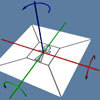
Investigate the molecular masses in this sequence of molecules and deduce which molecule has been analysed in the mass spectrometer.
Age 14 to 18
Challenge Level Yellow starYellow star
Article Primary curriculum Secondary curriculum

Symmetric Tangles

The tangles created by the twists and turns of the Conway rope trick are surprisingly symmetrical. Here's why!

Age 14 to 16
Article Primary curriculum Secondary curriculum

Tangles

A personal investigation of Conway's Rational Tangles. What were the interesting questions that needed to be asked, and where did they lead?
Age 11 to 16
Problem Primary curriculum Secondary curriculum

Cube Net

How many tours visit each vertex of a cube once and only once? How many return to the starting point?

Age 16 to 18
Challenge Level Yellow starYellow star
Problem Primary curriculum Secondary curriculum

Lost in Space

How many ways are there to count 1 - 2 - 3 in the array of triangular numbers? What happens with larger arrays? Can you predict for any size array?
Age 14 to 16
Challenge Level Yellow star
Problem Primary curriculum Secondary curriculum

Bell Ringing

Suppose you are a bellringer. Can you find the changes so that, starting and ending with a round, all the 24 possible permutations are rung once each and only once?
Age 11 to 14
Challenge Level Yellow starYellow star
Problem Primary curriculum Secondary curriculum

Ordered Sums

Let a(n) be the number of ways of expressing the integer n as an ordered sum of 1's and 2's. Let b(n) be the number of ways of expressing n as an ordered sum of integers greater than 1. (i) Calculate a(n) and b(n) for n<8. What do you notice about these sequences? (ii) Find a relation between a(p) and b(q). (iii) Prove your conjectures.


Age 14 to 16
Challenge Level Yellow starYellow star
Problem Primary curriculum Secondary curriculum

Factorial Fun

How many divisors does factorial n (n!) have?

Age 16 to 18
Challenge Level Yellow starYellow starYellow star
Problem Primary curriculum Secondary curriculum

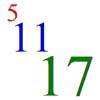
Postage

The country Sixtania prints postage stamps with only three values 6 lucres, 10 lucres and 15 lucres (where the currency is in lucres).Which values cannot be made up with combinations of these postage stamps? Prove that all other values can be made up.
Age 14 to 16
Challenge Level Yellow star
Problem Primary curriculum Secondary curriculum

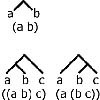
Counting Binary Ops

How many ways can the terms in an ordered list be combined by repeating a single binary operation. Show that for 4 terms there are 5 cases and find the number of cases for 5 terms and 6 terms.
Age 14 to 16
Challenge Level Yellow starYellow star
Problem Primary curriculum Secondary curriculum

Magic W Wrap Up

Prove that you cannot form a Magic W with a total of 12 or less or with a with a total of 18 or more.
Age 16 to 18
Challenge Level Yellow star
Article Primary curriculum Secondary curriculum

Ways of Summing Odd Numbers

Sanjay Joshi, age 17, The Perse Boys School, Cambridge followed up the Madrass College class 2YP article with more thoughts on the problem of the number of ways of expressing an integer as the sum of odd numbers.

Age 11 to 14
Article Primary curriculum Secondary curriculum

An Investigation Based on Score

Class 2YP from Madras College was inspired by the problem in NRICH to work out in how many ways the number 1999 could be expressed as the sum of 3 odd numbers, and this is their solution.
Age 11 to 14
Article Primary curriculum Secondary curriculum

The Eternity Puzzle

A big prize was offered for solving The Eternity Puzzle, a jigsaw with no picture and every piece is the same on both sides. The finished result forms a regular dodecagon (12 sided polygon).
Age 16 to 18
Article Primary curriculum Secondary curriculum

Transitivity

Suppose A always beats B and B always beats C, then would you expect A to beat C? Not always! What seems obvious is not always true. Results always need to be proved in mathematics.

Age 16 to 18
Article Primary curriculum Secondary curriculum

Links and Knots

Some puzzles requiring no knowledge of knot theory, just a careful inspection of the patterns. A glimpse of the classification of knots, prime knots, crossing numbers and knot arithmetic.

Age 14 to 18
Problem Primary curriculum Secondary curriculum

Master Minding

Your partner chooses two beads and places them side by side behind a screen. What is the minimum number of guesses you would need to be sure of guessing the two beads and their positions?
Age 11 to 14
Challenge Level Yellow starYellow star
Problem Primary curriculum Secondary curriculum

Domino Tetrads

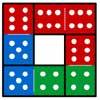
Is it possible to use all 28 dominoes arranging them in squares of four? What patterns can you see in the solution(s)?
Age 11 to 14
Challenge Level Yellow starYellow starYellow star
Problem Primary curriculum Secondary curriculum

Plate Spotting

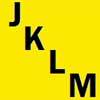
I was in my car when I noticed a line of four cars on the lane next to me with number plates starting and ending with J, K, L and M. What order were they in?

Age 7 to 11
Challenge Level Yellow starYellow starYellow star
Problem Primary curriculum Secondary curriculum

Deep Roots

Find integer solutions to: $\sqrt{a+b\sqrt{x}} + \sqrt{c+d.\sqrt{x}}=1$
Age 14 to 16
Challenge Level Yellow starYellow starYellow star
Problem Primary curriculum Secondary curriculum

Paving Paths

How many different ways can I lay 10 paving slabs, each 2 foot by 1 foot, to make a path 2 foot wide and 10 foot long from my back door into my garden, without cutting any of the paving slabs?

Age 11 to 14
Challenge Level Yellow starYellow star
Problem Primary curriculum Secondary curriculum

Euromaths

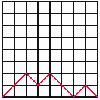
How many ways can you write the word EUROMATHS by starting at the top left hand corner and taking the next letter by stepping one step down or one step to the right in a 5x5 array?
Age 11 to 14
Challenge Level Yellow star
Problem Primary curriculum Secondary curriculum

Walkabout

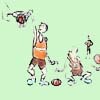
A walk is made up of diagonal steps from left to right, starting at the origin and ending on the x-axis. How many paths are there for 4 steps, for 6 steps, for 8 steps?
Age 14 to 16
Challenge Level Yellow starYellow star
Problem Primary curriculum Secondary curriculum

One Basket or Group Photo

Libby Jared helped to set up NRICH and this is one of her favourite problems. It's a problem suitable for a wide age range and best tackled practically.

Age 7 to 18
Challenge Level Yellow starYellow starYellow star
Problem Primary curriculum Secondary curriculum

How Many Dice?

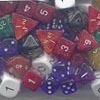
A standard die has the numbers 1, 2 and 3 are opposite 6, 5 and 4 respectively so that opposite faces add to 7? If you make standard dice by writing 1, 2, 3, 4, 5, 6 on blank cubes you will find there are 2 and only 2 different standard dice. Can you prove this ?
Age 11 to 14
Challenge Level Yellow star
Problem Primary curriculum Secondary curriculum

Flagging

How many tricolour flags are possible with 5 available colours such that two adjacent stripes must NOT be the same colour. What about 256 colours?

Age 11 to 14
Challenge Level Yellow starYellow star
Problem Primary curriculum Secondary curriculum

Greetings

From a group of any 4 students in a class of 30, each has exchanged Christmas cards with the other three. Show that some students have exchanged cards with all the other students in the class. How many such students are there?

Age 11 to 14
Challenge Level Yellow star
Problem Primary curriculum Secondary curriculum

Snowman

All the words in the Snowman language consist of exactly seven letters formed from the letters {s, no, wm, an). How many words are there in the Snowman language?
Age 14 to 16
Challenge Level Yellow star
Problem Primary curriculum Secondary curriculum

Cube Paths

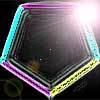
Given a 2 by 2 by 2 skeletal cube with one route `down' the cube. How many routes are there from A to B?
Age 11 to 14
Challenge Level Yellow starYellow star
Problem Primary curriculum Secondary curriculum

Penta Colour

In how many different ways can I colour the five edges of a pentagon so that no two adjacent edges are the same colour?
Age 14 to 16
Challenge Level Yellow star
Problem Primary curriculum Secondary curriculum

Scratch Cards

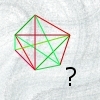
To win on a scratch card you have to uncover three numbers that add up to more than fifteen. What is the probability of winning a prize?
Age 14 to 16
Challenge Level Yellow starYellow starYellow star
Problem Primary curriculum Secondary curriculum

Tri-colour

Six points are arranged in space so that no three are collinear. How many line segments can be formed by joining the points in pairs?

Age 11 to 14
Challenge Level Yellow starYellow star
Problem Primary curriculum Secondary curriculum

Painting Cubes

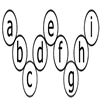
Imagine you have six different colours of paint. You paint a cube using a different colour for each of the six faces. How many different cubes can be painted using the same set of six colours?
Age 11 to 14
Challenge Level Yellow starYellow starYellow star
Problem Primary curriculum Secondary curriculum

W Mates

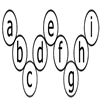
Show there are exactly 12 magic labellings of the Magic W using the numbers 1 to 9. Prove that for every labelling with a magic total T there is a corresponding labelling with a magic total 30-T.
Age 16 to 18
Challenge Level Yellow star
Problem Primary curriculum Secondary curriculum

Knight Defeated

The knight's move on a chess board is 2 steps in one direction and one step in the other direction. Prove that a knight cannot visit every square on the board once and only (a tour) on a 2 by n board for any value of n. How many ways can a knight do this on a 3 by 4 board?
Age 14 to 16
Challenge Level Yellow star
Problem Primary curriculum Secondary curriculum

Magic W

Find all the ways of placing the numbers 1 to 9 on a W shape, with 3 numbers on each leg, so that each set of 3 numbers has the same total.

Age 14 to 16
Challenge Level Yellow starYellow star
Problem Primary curriculum Secondary curriculum

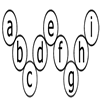
Olympic Magic

in how many ways can you place the numbers 1, 2, 3 … 9 in the nine regions of the Olympic Emblem (5 overlapping circles) so that the amount in each ring is the same?

Age 14 to 16
Challenge Level Yellow starYellow star
Problem Primary curriculum Secondary curriculum

Plum Tree

Label this plum tree graph to make it totally magic!

Age 14 to 18
Challenge Level Yellow star
Problem Primary curriculum Secondary curriculum

Magic Caterpillars

Label the joints and legs of these graph theory caterpillars so that the vertex sums are all equal.
Age 14 to 18
Challenge Level Yellow starYellow starYellow star
Problem Primary curriculum Secondary curriculum

Euler's Officers

How many different ways can you arrange the officers in a square?
Age 14 to 16
Challenge Level Yellow star
Problem Primary curriculum Secondary curriculum

N000ughty Thoughts

How many noughts are at the end of these giant numbers?
Age 14 to 16
Challenge Level Yellow star
Problem Primary curriculum Secondary curriculum

Snooker

A player has probability 0.4 of winning a single game. What is his probability of winning a 'best of 15 games' tournament?
Age 16 to 18
Challenge Level Yellow star
Problem Primary curriculum Secondary curriculum

Russian Cubes

I want some cubes painted with three blue faces and three red faces. How many different cubes can be painted like that?

Age 14 to 16
Challenge Level Yellow star
Problem Primary curriculum Secondary curriculum

Doodles

Draw a 'doodle' - a closed intersecting curve drawn without taking pencil from paper. What can you prove about the intersections?

Age 14 to 16
Challenge Level Yellow star

  • Tech help
  • Accessibility Statement
  • Sign up to our newsletter
  • Twitter X logo

The NRICH Project aims to enrich the mathematical experiences of all learners. To support this aim, members of the NRICH team work in a wide range of capacities, including providing professional development for teachers wishing to embed rich mathematical tasks into everyday classroom practice.

NRICH is part of the family of activities in the Millennium Mathematics Project.

University of Cambridge logo NRICH logo